


You notice it in the shower drain, or in the brush, or in a photo where your part looks wider than you remember. Hair loss in perimenopause is common, close to half of women see noticeable thinning by 50, but “common” doesn’t make it less distressing, and the standard advice (better shampoo, biotin, wait it out) mostly misses why it’s happening.
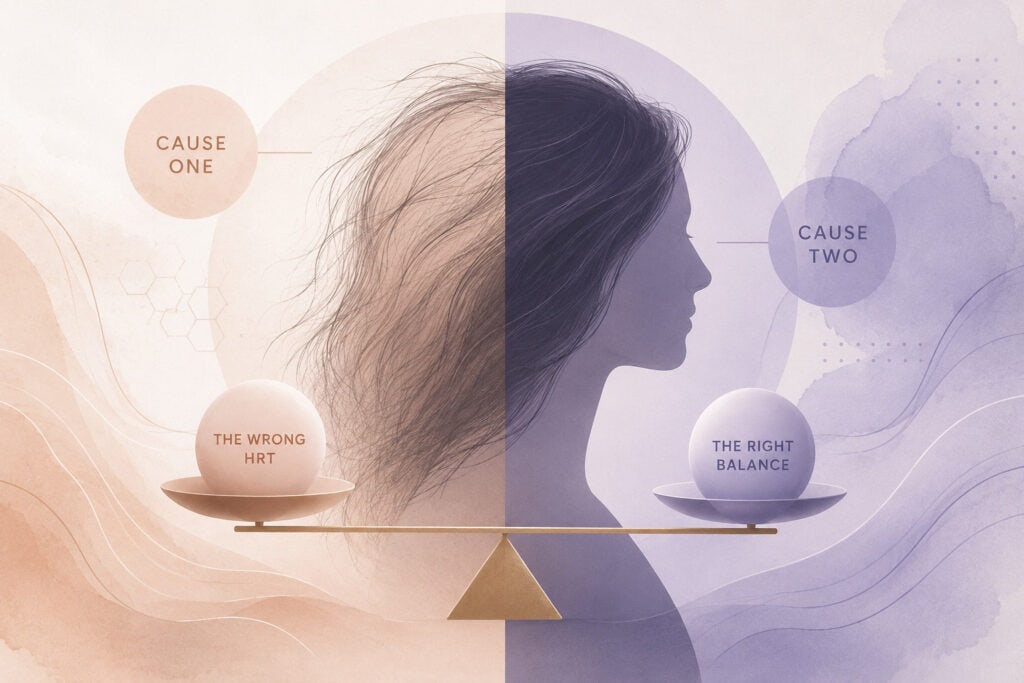
There are two separate reasons it happens. One is falling estrogen, which HRT reverses well. The other is androgen-driven thinning, which HRT helps less, and which the wrong progestogen can worsen. Which one you have determines whether HRT is the fix or part of the problem.
Two Types Of Hair Loss In Perimenopause: How To Identify Yours
Before any treatment decision, identify what you’re actually looking at. The two types look different and behave differently.
| Feature | Telogen effluvium | Androgenic alopecia |
| Cause | Estrogen decline disrupts the hair growth cycle | Rising androgen-to-estrogen ratio |
| Pattern | Diffuse shedding across the whole scalp | Patterned, crown, top of scalp, widening part |
| Onset | Often sudden, follows a hormonal shift | Gradual, progressive |
| Hair texture | Normal hair, just more of it shedding | Miniaturization, hairs become finer |
| HRT response | Usually good | Partial, depends on progestogen choice |
| Who gets it | Most perimenopausal women | Genetically predisposed women |
The fastest way to tell them apart is where and how it happens. If you’re finding more hair everywhere, on the pillow, in the shower, in the brush, but the hair itself looks normal, that’s telogen effluvium (a shedding-phase disruption). If your part is widening, your crown is thinning, and the individual hairs are getting visibly finer, that’s androgenic alopecia (also called female pattern hair loss), where follicles are shrinking rather than just shedding.
Key takeaway: Diffuse shedding of normal hair points to estrogen decline and responds well to HRT. Patterned thinning with finer hairs points to androgens, where the progestogen you choose can help or harm. Many women have both, and need a plan that addresses each.
How Estrogen Affects Hair Growth
The mechanism behind this is worth understanding, because it explains both why the shedding happens and why HRT reverses it.
Your hair grows in cycles. The anagen phase is the active growth phase, lasting years, and at any given time roughly 85–90% of your follicles are in it. Estrogen’s job is to prolong anagen, to keep follicles in the growth phase longer.
When estrogen declines through perimenopause, that signal weakens, and more follicles shift simultaneously into the telogen phase (the resting-then-shedding phase). The result is the sudden, diffuse shedding that defines telogen effluvium, sometimes up to 15% more follicles switching into shedding mode at once, which is why it can feel like it happened overnight.
There’s a second mechanism that bridges to the androgenic type: estrogen also counterbalances androgens, specifically DHT (dihydrotestosterone), the androgen that miniaturizes follicles in genetically susceptible women. So estrogen doesn’t just extend growth; it also offsets the hormone driving pattern thinning. When estrogen falls, both protections fade at once.
Restoring estrogen via HRT normalizes the cycling, and shedding reduces over 3–6 months as follicles return to the growth phase.
What HRT does for each type of hair loss
- For Telogen Effluvium
Restoring estrogen re-extends the anagen phase, the abnormal shedding settles, and follicles return to normal cycling. Most women see reduced shedding within 3–6 months and gradual regrowth over 6–12 months. This is the type most likely to respond well to standard HRT, and the response can be substantial.
- For Androgenic Alopecia
Here HRT helps partially but isn’t the whole answer, and this is where the progestogen choice becomes decisive. Estrogen partially counterbalances the androgens driving the miniaturization, so HRT provides some benefit.
But the progestogen component matters enormously, because some synthetic progestins have androgenic activity of their own, and adding an androgenic progestogen to androgen-driven hair loss is working against yourself. That’s the entire subject of the next section, and it’s the most important thing on this page.
The Progestogen Variable: The Most Important And Least-Discussed Factor In HRT And Hair
This section contains the highest-value information in the article, because most HRT prescriptions never account for it. If you have a uterus, you need a progestogen alongside estrogen to protect the uterine lining, but progestogens are not interchangeable, and their androgenic activity varies enormously.
| Progestogen | Androgenic activity | Effect on androgenic hair loss |
| Norethisterone (norethindrone) | High | Can worsen androgenic alopecia |
| Levonorgestrel | Moderate–high | Can worsen androgenic alopecia |
| Medroxyprogesterone acetate (MPA) | Moderate | May worsen androgenic alopecia |
| Dydrogesterone | Low | Generally neutral |
| Micronized progesterone | None | Best choice for hair-sensitive women |
| Drospirenone | Anti-androgenic | May benefit androgenic alopecia |
From the table above, several synthetic progestins are derived from testosterone and retain some of its androgenic activity. Levonorgestrel and norethisterone are the most androgenic, levonorgestrel is structurally closer to testosterone than to progesterone in its receptor effects.
At the other end, micronized progesterone (the bioidentical form) has no androgenic activity, and drospirenone is actually anti-androgenic, derived from spironolactone, the same drug dermatologists prescribe for androgenic hair loss.
What to do: if you’re experiencing patterned hair loss and you’re on HRT, ask your provider specifically about switching to micronized progesterone or a progestogen with anti-androgenic properties. This is a recognized clinical adjustment, not an unusual request.
Note: the androgenic-activity differences between progestogens are well established, but the evidence that switching progestogens reliably regrows hair is limited and not confirmed by large trials. What you’re doing by switching is removing a possible accelerant, which is worthwhile, rather than guaranteeing regrowth.
Frame your expectation accordingly, you’re stopping the wrong progestogen from working against you, not buying a cure.
Other causes of hair loss to rule out, even alongside HRT
Hair loss in perimenopause frequently has more than one driver, and HRT only addresses the hormonal one. These need to be checked and treated separately.
| Cause | Test | Notes |
| Hypothyroidism | TSH + free T4 | Extremely common in this age group; produces near-identical symptoms |
| Iron deficiency / low ferritin | Serum ferritin | Hair needs a higher level than the lab “normal”, target >70 ng/mL |
| Nutritional deficiency | Zinc, vitamin D | Less common but worth checking |
| Androgenic alopecia (genetic) | Clinical assessment | May warrant dermatology referral |
The ferritin cause is the one most often missed, and it’s specific: hair has a higher iron requirement than the rest of the body. Ferritin below 70 ng/mL correlates with hair shedding independently of anemia, which means a woman can be told her iron is “normal” (because the lab’s anemia threshold is far lower, often around 15–30) while her hair is starving for iron at a level of 40.
Note that this is a higher target than for fatigue alone; hair is more demanding. And thyroid dysfunction produces hair loss indistinguishable from the hormonal kind, which is why TSH belongs in any perimenopausal hair-loss workup.
HRT will not resolve hair loss driven by low iron or an underactive thyroid, no matter the dose. Rule these out, or treat them in parallel, rather than assuming estrogen is the whole story.
Realistic Timeline And What Improvement Looks Like on HRT for Hair Loss
Hair responds slowly to any intervention, because you’re waiting on the growth cycle itself. Expectations matter here more than almost anywhere.
| Timeline | What to expect |
| Weeks 1–4 | Shedding may temporarily increase, unsettling, but a normal part of the cycle resetting |
| Months 1–3 | Shedding begins to reduce |
| Months 3–6 | New growth becomes visible, typically fine, short hairs first |
| Months 6–12 | Meaningful regrowth in telogen effluvium cases |
| 12+ months | Maximum benefit reached; assess any remaining loss separately |
First, the early shedding increase in weeks 1–4 frightens women into quitting, but it’s often the old resting hairs being pushed out as new growth begins underneath. It can be a sign the cycle is resetting, not failing.
Second, androgenic alopecia regrowth is slower and less complete than telogen effluvium recovery, the miniaturized follicles take longer and may not fully recover, which is why setting the expectation by type matters.
HRT and Skin, What Estrogen Does
The same estrogen decline behind hair changes also affects skin, through a different protein: collagen. Estrogen stimulates collagen synthesis, and the loss after menopause is steep, research in the American Journal of Clinical Dermatology found women lose approximately 30% of their skin collagen in the first five years after menopause, with continued decline after.
That collagen loss is what produces the thinning, fine lines, and loss of elasticity many women notice in the same window as the hair changes.
Women on HRT tend to maintain better skin thickness, hydration, and elasticity. As with hair, improvement is gradual, expect 3–6 months for noticeable change. Transdermal estrogen, delivered through the skin, may offer a modest additional local benefit to skin compared with oral forms, since it reaches the skin directly.
What To Do Next
If you’re considering HRT for hair loss, start by identifying the type of hair loss you have. Then make sure your HRT formulation is hair-friendly, check that your ferritin is above the level associated with healthy hair growth, not just above the anemia threshold, and rule out thyroid dysfunction. Miss any of those steps, and you risk treating the wrong cause or overlooking one that’s still driving hair loss.
The key takeaway is that HRT doesn’t have a single effect on hair, it can help or hinder depending on the biology involved and the formulation you use. At TRTMD, we take a hair-aware approach to HRT, evaluating the hormonal and non-hormonal factors together so treatment supports hair health instead of working against it.
