



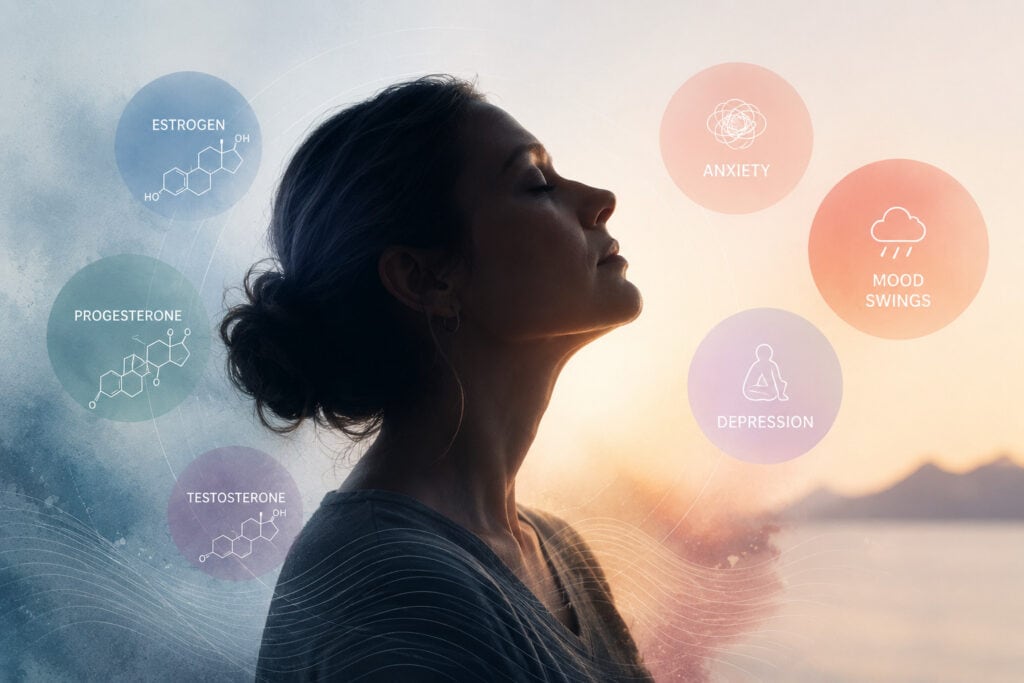
If your anxiety, mood swings, or depression started or worsened in perimenopause, the cause is likely hormonal. HRT frequently resolves these symptoms, and for the right woman it works as well as anything else available.
But the progestogen component of some HRT formulations can cause or worsen the exact symptoms you’re trying to treat. This is why some women feel worse on HRT, and why “HRT didn’t work for me” is, surprisingly often, “the wrong progestogen didn’t work for me. Here’s how to tell the difference and choose the right treatment path for you.
How to tell if your mood symptoms are hormonally driven, a self-assessment
Before going further, answer these. The pattern of your answers tells you more than any single symptom does.
| Question | Hormonal signal |
| Did symptoms start or significantly worsen in your 40s or around menopause? | Yes = hormonal pattern |
| Do symptoms fluctuate with your cycle, worse in the week before your period? | Yes = hormonal pattern |
| Do you also have physical symptoms, hot flashes, sleep disruption, joint pain? | Yes = hormonal pattern |
| Did symptoms appear without a clear psychological trigger or life event? | Yes = hormonal pattern |
| Have antidepressants not worked, or worked less well than expected? | Possible hormonal driver |
Three or more “yes” answers strongly suggests a hormonal component. That doesn’t rule out an independent psychiatric condition, it means hormones are likely contributing and should be assessed, not overlooked in favor of an automatic antidepressant prescription.
Key takeaway: Timing and pattern are the tell. Mood symptoms that track your cycle, arrived with the menopausal transition, and travel alongside physical symptoms are hormonal until proven otherwise.
How estrogen and progesterone affect mood, anxiety, and emotional regulation
The mood effects of these hormones run through specific, measurable brain chemistry, and understanding the mechanism explains why HRT helps some women and not others.
Estrogen and serotonin
Estrogen shapes mood through serotonin, the brain chemical most tied to emotional stability and the main target of antidepressants. It raises serotonin two ways at once: it helps the brain make more, and it slows the enzyme that breaks it down. The result is stronger serotonin signaling, through essentially the same system antidepressants act on.
So when estrogen fluctuates or declines, serotonin signaling becomes unstable, which is why perimenopausal mood disruption is so often misdiagnosed as a primary depression or anxiety disorder. A brain-imaging study in Biological Psychiatry confirmed the link directly: changing estrogen levels measurably shifted serotonin activity in the brain.
Progesterone, allopregnanolone, and GABA
Progesterone doesn’t just act on reproductive tissue, it also has a direct effect on the brain. When your body breaks down progesterone, one of the byproducts is a compound called allopregnanolone, which works on the same receptors that regulate calm and sleep. These receptors, known as GABA-A receptors, are essentially the brain’s natural braking system. Drugs like benzodiazepines (Valium, Xanax) target them too, which is why progesterone can have a mild but noticeable effect on anxiety and sleep in some women.
The catch in perimenopause is volatility. As cycles become erratic, progesterone swings sharply, and that braking signal swings with it, producing anxiety and irritability instead of calm.
Cortisol amplification in perimenopause
There’s a third mechanism, and it’s about stress. Estrogen normally helps the brain keep its stress response in check, so as estrogen declines, the same stressful situation produces a bigger surge of the body’s main stress hormone, cortisol, than it would have a few years earlier.
This reframes a common experience. The woman who feels she “suddenly can’t handle stress the way she used to” isn’t imagining it and isn’t weak, estrogen was quietly part of how her brain absorbed stress, and its decline took that buffer away.
What HRT does for anxiety, the evidence
HRT is most effective for anxiety that is new-onset in perimenopause and tracks hormonal fluctuation. Studies show estrogen reduces anxiety symptoms in these women, especially when it’s given through the skin, as a patch or gel rather than a pill. Skin delivery (the clinical term is transdermal) keeps estrogen levels steady, where a swallowed dose rises and falls through the day, and since the anxiety is driven by hormonal swings in the first place, a steady level is what settles it.
It’s less effective for baseline anxiety disorders that predate perimenopause. If you’ve had generalized anxiety since your 20s, HRT may reduce its severity somewhat, particularly if perimenopause has made it worse, but it isn’t a substitute for the treatment that addresses the underlying disorder.
Timeline worth knowing: anxiety symptoms often respond faster than hot flashes. Some women report meaningful improvement within 2–4 weeks of starting, earlier than the 4–8 weeks typical for vasomotor symptoms.
What HRT does for mood swings
Mood swings in perimenopause are driven by estrogen volatility, not simply low estrogen. This distinction is the key to treating them. Erratic fluctuation, the rapid rises and crashes of the transition, is more destabilizing to mood than a steady low level would be.
That’s why HRT helps mood swings specifically by stabilizing estrogen rather than just raising it. It also explains why the type of regimen matters. A sequential regimen deliberately varies your hormone levels across the month to produce a monthly bleed, and that built-in variation can recreate the very swings driving the mood problem.
A continuous regimen, which keeps both hormones at the same steady level every day with no bleed, avoids that, which is why it usually serves a woman whose main complaint is emotional instability better than a cyclical one.
Key takeaway: for mood swings, stability is the therapeutic goal. The regimen that holds hormones steadiest tends to outperform the one that deliberately cycles them.
What HRT does for depression, and when it doesn’t work
This is where the most important clinical distinction in the entire topic lives, and where most content fails women by being too general.
- Hormonally-driven depression, new onset in perimenopause
Depression appearing for the first time in perimenopause, particularly in a woman with no prior psychiatric history, is frequently hormone-driven, and this is where HRT’s evidence is strongest. The pivotal trial, Soares and colleagues in Archives of General Psychiatry, gave perimenopausal women with clinically significant depression transdermal estradiol or placebo: 68% on estradiol achieved remission, versus 20% on placebo. That’s an antidepressant-grade response.
The critical qualifier is perimenopausal. Trials show HRT reduces depressive symptoms far more in perimenopausal women than postmenopausal ones, a parallel trial in postmenopausal women found no benefit over placebo.
The reason is what’s driving the depression: in perimenopause it’s estrogen swinging erratically, which HRT smooths out; by postmenopause the swinging has stopped and estrogen has settled low, so the mood symptoms are less hormonal and there’s less for HRT to fix. The timing window matters for mood, just as it does for cognition.
- Pre-existing or independent depression
HRT may modestly improve depression that predates perimenopause, but it is not a primary treatment for it. If your depression started in your 20s or 30s, the hormonal change isn’t its cause, and treating it as if hormones are the driver delays effective care. Women with a psychiatric history should approach HRT as a possible adjunct to existing treatment, not a replacement for it.
When to involve a psychiatrist alongside HRT
If depressive symptoms are severe, involve any suicidal thoughts, or haven’t improved after three months of adequate HRT, psychiatric evaluation should happen in parallel, not instead of HRT. These aren’t competing paths. Severe or treatment-resistant depression needs psychiatric care regardless of the hormonal picture, and any depression with active suicidality is a medical priority, not a hormone-management question.
The takeaway: if your depression is hormonal in origin and perimenopausal in timing, HRT is one of the most effective tools available. The further your depression sits from that profile, the more it needs treatment HRT can’t provide.
Progestogen sensitivity, the reason some women feel worse on HRT
This is the most underreported variable in HRT and mood, and the most common reason women abandon HRT unnecessarily.
If you have a uterus, you need a progestogen alongside estrogen to protect the uterine lining. That isn’t optional. But the progestogen is also the component most likely to harm mood in sensitive women, and recognizing that quickly is what prevents a woman from quitting a treatment that was otherwise working.
What progestogen sensitivity looks like
Some women experience clear worsening of anxiety, depression, irritability, or mood instability specifically from the progestogen, not the estrogen. The timing usually gives it away.
| Symptom pattern | What it suggests |
| Mood was fine on estrogen-only, worsened when progestogen was added | Progestogen sensitivity |
| Symptoms were worse in the second half of the cycle before starting HRT | Pre-existing progesterone sensitivity |
| Anxiety or depression started after switching progestogen brand | Formulation-specific sensitivity |
Progesterone calms most women, but a small share, roughly 5–10%, get the opposite. The same braking system that settles most people misfires in some, producing restlessness or anxiety instead, the same paradoxical response a minority have to benzodiazepines. If you’re one of them, it isn’t “in your head”, it’s recognized, and it means a different progestogen is worth trying.
Synthetic progestins vs. micronized progesterone, why the difference matters
The distinction is mechanical. Synthetic progestins, norethisterone, medroxyprogesterone acetate, levonorgestrel, do not produce allopregnanolone. They protect the uterine lining but carry none of the calming GABA benefit, and in sensitive women they can actively worsen mood.
Micronized progesterone (sold as Prometrium or Utrogestan) is different, it’s structurally identical to the progesterone your own body makes, which is what “bioidentical” means. Because of that, it breaks down into allopregnanolone the way your natural progesterone does, so it keeps the calming effect the synthetics lack, and it has a markedly better mood profile in sensitive women.
What to do if you suspect progestogen sensitivity
Tell your provider directly: “I think my progestogen may be affecting my mood, can we switch to micronized progesterone?” This is a recognized clinical adjustment, not an unusual request. If your provider isn’t familiar with the distinction, that’s a reasonable point to seek out a menopause specialist.
The trade-off: micronized progesterone is the mood-friendly default for the majority. For the small group who respond paradoxically even to it, naming the effect early is what prevents months of confused treatment and unnecessary abandonment of HRT.
What to do next
Before your next appointment, equip yourself with these three key pieces of information:
- When your mood symptoms started relative to perimenopause, new-onset or worsening in your 40s points toward a hormonal driver and the strongest evidence for HRT.
- Whether they correlate with your cycle, symptoms that flare in the week before your period are a hormonal signature.
- If you’re already on HRT, whether your mood changed after the progestogen component was added, this single observation is what distinguishes progestogen sensitivity from treatment failure.
These details tell a clinician whether your mood symptoms are hormonal, what kind, and whether the HRT you may already be taking is part of the solution or part of the problem.
If you want an evaluation that takes that timeline seriously, gets the progestogen choice right the first time rather than after months of feeling worse, and is honest about when hormones are the answer and when they aren’t, that’s what a consultation at TRTMD is built around. Bring the three pieces of information above. They’re the start of a far more useful conversation than the one most women are offered.
