



You’re eating the way you always have. Your habits haven’t changed. But somewhere around 47, the weight started settling across your midsection, in a place it never used to. So you read that HRT helps with menopausal weight, started it, and watched the scale hold steady.
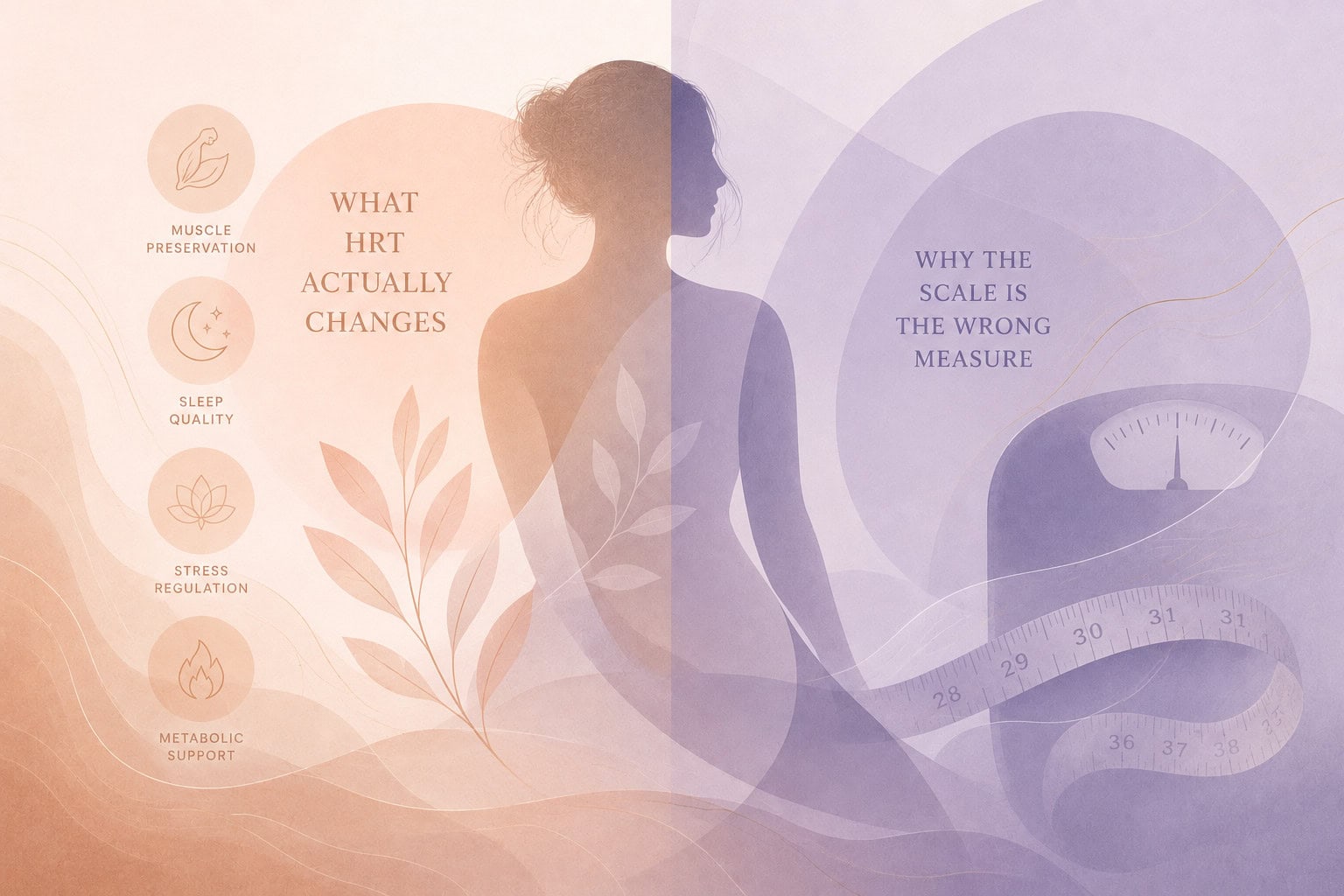
Here’s the part nobody explains: the scale was never the thing to watch. Menopause relocates weight as much as it adds it, moving it out of your hips and into your abdomen, where it does real metabolic damage. HRT works against that relocation. The benefit is real; it just shows up somewhere you probably haven’t been looking.
Why Menopause Changes Body Composition, Even Without Dietary Changes
Here’s the validating truth for any woman who feels her body changed while she did everything the same: it did, and the driver is hormonal. Declining estrogen triggers three metabolic changes at once.
| Change | What it produces |
| Fat redistribution from subcutaneous to visceral | Abdominal weight gain, increased metabolic risk |
| Loss of lean muscle mass | Lower resting metabolic rate |
| Reduced insulin sensitivity | More efficient fat storage, harder fat loss |
These happen largely independently of how much you eat. A cross-sectional study across the menopausal transition found postmenopausal women had significantly lower lean mass and significantly higher visceral fat than premenopausal women across every body-size category, and, strikingly, the shift was most pronounced in normal-weight women, whose visceral fat climbed even as their total weight stayed stable.
The woman who eats and exercises exactly as she did at 38 gains weight differently at 48. Same inputs, different distribution. The muscle loss compounds it: less muscle means a lower resting metabolic rate (the calories you burn doing nothing), so the same diet that maintained her weight now slowly adds to it.
This is a metabolic shift with a hormonal cause. Understanding that is the difference between treating the actual driver and blaming yourself for it.
Visceral Fat and Subcutaneous Fat Are Different, and HRT Targets the One That Matters
Subcutaneous fat sits just under the skin, the pinchable fat on hips and thighs. Visceral fat accumulates deep in the abdomen, wrapped around your internal organs.
They look different, and far more importantly, they behave differently. Visceral fat is metabolically active in ways subcutaneous fat is not: it actively drives inflammation, insulin resistance, and cardiovascular risk. Subcutaneous fat is largely inert storage by comparison.
The scale cannot tell the two apart. A woman who loses some subcutaneous fat from her hips while gaining visceral fat in her abdomen can weigh exactly the same, while her actual health risk has climbed. Her weight chart looks like nothing happened, and her metabolic risk says otherwise.
HRT’s primary body composition benefit is attenuating the shift toward visceral fat. That makes the metrics that actually reflect what HRT is doing your waist circumference and how your clothes fit at the waist, rather than total body weight. Track only the scale and you’ll miss the benefit entirely.
Where the fat sits matters more than how much you weigh. HRT works on the dangerous compartment, and that compartment is invisible to a bathroom scale.
What HRT Actually Does To Body Composition: The Evidence
Honest evidence-grading matters here, so here’s what the research actually supports.
| Effect | Evidence level | What it means practically |
| Reduces visceral fat accumulation | Good | Slows abdominal gain, not necessarily total weight |
| Preserves lean muscle mass | Moderate | Supports metabolic rate and physical function |
| Improves insulin sensitivity | Moderate (formulation-dependent) | Less efficient fat storage, better glucose handling |
| Produces weight loss on the scale | Weak to none | Do not expect the number to drop on HRT alone |
The visceral fat evidence is the strongest leg. The OsteoLaus cohort study found menopausal hormone therapy was associated with reduced total and visceral adiposity, and a meta-analysis of over 100 randomized trials concluded that both oral and transdermal estrogen reduce abdominal fat, increase lean body mass, and improve insulin resistance in women without diabetes.
A Women’s Health Initiative substudy found women on estrogen-plus-progestin lost significantly less lean tissue over three years than women on placebo (−0.04 kg vs. −0.44 kg), a real preservation effect, though a small one.
Worth stating plainly: women on HRT don’t lose meaningfully more total weight than women who aren’t on it. The benefit lives somewhere other than the scale, and any source promising HRT-driven weight loss is overselling it.
One randomized trial of oral conjugated estrogen plus the synthetic progestin medroxyprogesterone acetate found that particular combination temporarily reduced insulin sensitivity without changing body composition. That finding points directly to the next section: the formulation matters.
HRT reliably improves the quality and location of body composition. What it changes far less reliably is the quantity. Expect the first and you’re being realistic; expect the second and you set yourself up to abandon a treatment that’s working.
Which HRT Formulation Has The Best Metabolic Profile
Metabolically, HRT varies a lot by formulation: both the route and the progestogen choice matter.
| Formulation | Metabolic consideration |
| Transdermal estrogen | Bypasses the liver; neutral effect on triglycerides and IGF-1 |
| Oral estrogen | First-pass liver metabolism raises triglycerides, lowers IGF-1, less favorable metabolically |
| Micronized progesterone | Metabolically neutral |
| Synthetic progestins (MPA) | Some androgenic activity; may affect insulin sensitivity |
| Testosterone | Supports muscle mass; improves body composition in women with deficiency |
When you swallow estrogen, it passes through the liver in high concentration before reaching the rest of your body, and that triggers hepatic changes that injectables and patches don’t.
A head-to-head randomized crossover study found oral conjugated estrogen significantly lowered IGF-1 (a marker tied to muscle and tissue maintenance) and more than doubled C-reactive protein (an inflammation marker), while transdermal estradiol left both untouched. Oral estrogen also stimulates the liver to produce more triglycerides; transdermal does not.
So for a woman whose metabolic health and body composition are primary concerns alongside her vasomotor symptoms, transdermal estradiol paired with micronized progesterone is the formulation best supported by current evidence. The synthetic-progestin-plus-oral-estrogen combination is the one to specifically ask about avoiding when body composition is the goal.
Testosterone deserves a mention too. In women with genuine deficiency, it supports muscle mass and can improve body composition, with the effect strongest when paired with resistance training. It’s prescribed off-label for women, so treat it as a tool worth knowing about rather than a default.
What HRT Won’t Do, And What You Need Alongside It
HRT is not a weight loss treatment. Worth stating plainly, because it’s the single most common misunderstanding: a woman who starts HRT specifically to lose weight and changes nothing else is likely to be disappointed.
What HRT does is create a more favorable hormonal environment. It doesn’t supply the stimulus that actually builds muscle and burns fat. Here’s what does move body composition in menopausal women:
| Intervention | Primary effect | Evidence |
| Resistance training | Muscle preservation and growth | Strong |
| Protein intake (1.2–1.6 g/kg/day) | Prevents muscle loss during a calorie deficit | Strong |
| Sleep optimization | Reduces cortisol-driven fat storage | Moderate |
| GLP-1 therapy (semaglutide, tirzepatide) | Direct fat loss, including visceral | Strong, for significant metabolic weight gain |
Resistance training is the non-negotiable one. It directly counteracts the muscle loss that lowers metabolic rate, and HRT appears to make that training more effective by supporting the hormonal environment muscle is built in.
Adequate protein protects muscle during any calorie deficit. And for women with significant metabolic weight gain, GLP-1 medications produce direct fat loss, including visceral fat, beyond what HRT delivers on its own. These work alongside HRT rather than against it; some women appropriately use HRT and a GLP-1 together, addressing different problems at once.
Think of HRT as the soil and resistance training, protein, and sleep as the seeds. It creates the conditions where they work better, and it can replace none of them. On its own, it won’t transform body composition.
How To Measure Whether HRT Is Working For Body Composition
Measure the wrong thing and you’ll draw the wrong conclusion, and probably quit a treatment that’s helping. Use metrics that can actually see the change HRT produces.
| Metric | More useful than the scale? | How to track |
| Waist circumference | Yes, tracks visceral fat directly | Measure at the navel, same time each week |
| How clothes fit at the waist | Yes | Practical daily signal |
| DEXA scan body composition | Yes, the gold standard | Available at most radiology centers |
| Scale weight | No, misleading without context | Use only alongside other measures |
Waist circumference is the highest-value home metric: it tracks the visceral fat compartment HRT actually works on, and it’s free. A DEXA scan (a body composition scan that separates fat, muscle, and bone) is the gold standard if you want precise data and a true baseline. The scale, used alone, actively misleads here, because it’s the one tool that can’t distinguish the healthy change from no change at all.
What To Do Next
If you take one thing from this article, let it be this: stop relying on the scale alone. Measure your waist circumference instead, taking it at your navel under the same conditions each week. It’s a far better indicator of the metabolic changes HRT can produce than body weight by itself.
Then support HRT with the things it can’t do on its own: regular resistance training and adequate protein intake from day one. Together, they help preserve lean muscle, improve body composition, and make any changes on the scale more meaningful.
If you’re considering HRT for weight concerns, aim for better metabolic health and body composition rather than a smaller number. That’s the approach we take at TRTMD, tailoring treatment to your symptoms, goals, and baseline measurements rather than the number on the scale.
