




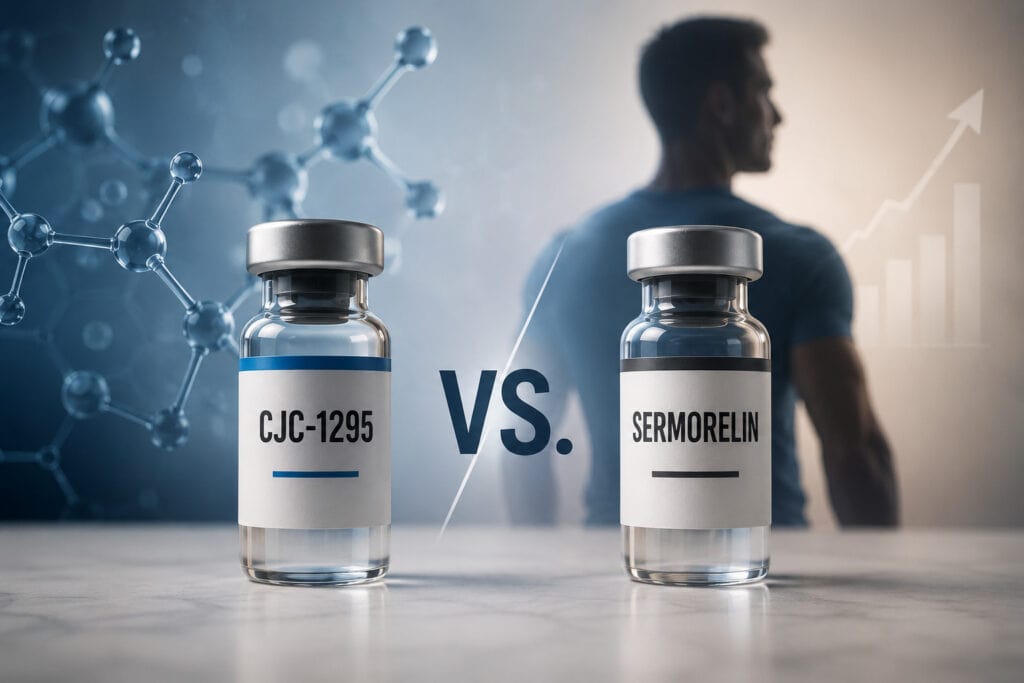
Sermorelin is, in most US clinics, no longer legally available the way it was two years ago. CJC-1295 never really was. That fact alone reshapes the choice between them more than any half-life comparison ever has, and most of what’s written about these peptides still hasn’t acknowledged it.
CJC-1295 vs. Sermorelin: the decision in one table
| Your situation | Better-fit peptide | Why |
| New to GH peptide therapy, anti-aging focus | Sermorelin | Mimics natural GH rhythm closely; gentlest entry point |
| Want fewer injections, willing to pay more | CJC-1295 with DAC | 8-day half-life; once- or twice-weekly dosing |
| Body composition / performance focus, daily injections OK | CJC-1295 without DAC (Modified GRF 1-29) | Stronger, more sustained pulse per injection than sermorelin |
| Long history of GH peptide use, wanting to step up | CJC-1295 (either form) | Bigger GH response than sermorelin at standard doses |
| Concerned about long-term, supra-physiological GH exposure | Sermorelin | Short pulse preserves natural feedback loop most fully |
| Sleep quality is the primary goal | Sermorelin (bedtime dosing) | Short pulse aligns with natural overnight GH surge |
Key takeaway: Sermorelin is the gentler, more physiological option. CJC-1295 is the stronger, longer-acting one, and the choice between the two CJC forms (with vs. without DAC) is its own decision that most articles skip past entirely. Schedule a Consultation
What Sermorelin is and how it works
Sermorelin is a 29-amino-acid synthetic peptide that mimics growth hormone-releasing hormone (GHRH), the natural signal your hypothalamus sends to your pituitary gland telling it to release growth hormone. It binds the same pituitary receptor as your body’s own GHRH and produces the same downstream effect: a pulse of endogenous (your-own-body’s) GH.The defining feature is its short half-life, roughly 10–20 minutes. That short window is the source of both its strengths and its limitations:
- Strength: the GH pulse it produces closely mirrors what your body would do naturally. Your pituitary (the small gland at the base of your brain that releases GH) isn’t held in a prolonged “on” state, it pulses, then resets, then is ready for the next natural signal.
- Limitation: because the signal is brief, sermorelin generally requires daily injection, typically at bedtime to coincide with your body’s largest natural overnight GH surge.
Why this matters clinically: sermorelin is the closest pharmacological approximation of normal GH physiology in this category. The natural feedback loop, where GH rising in the blood signals back to suppress further release (a process called negative feedback), stays largely intact. That makes sermorelin harder to overshoot, which is part of why it’s often the first-line GH peptide for anti-aging use.
What CJC-1295 is, and why “with DAC” vs. “without DAC” matters more than most articles admit
CJC-1295 is also a GHRH analog. Same pituitary receptor as sermorelin, same downstream GH release. The molecule has been modified to stay active in the body longer. That modification creates two distinct versions of CJC-1295 that behave like different drugs in practice, and lumping them together as “CJC-1295” is where most online comparisons go wrong.
CJC-1295 with DAC (long-acting)
DAC stands for Drug Affinity Complex, a chemical addition that lets the peptide bind to albumin, the most abundant protein in your blood. Bound to albumin, the peptide circulates in the bloodstream for days rather than minutes.
- Half-life: approximately 8 days
- Dosing: typically once or twice weekly
- Effect: a prolonged, steady elevation in GH and IGF-1 (the downstream hormone GH stimulates the liver to produce)
The convenience is real. The trade-off is that you’re holding the GH signal on continuously rather than pulsing it, which moves further away from natural physiology and partially overrides the negative feedback loop that protects against over-stimulation.
CJC-1295 without DAC (short-acting, also called Modified GRF 1-29)
This is the version most modern peptide clinics actually use.
- Half-life: roughly 30 minutes
- Dosing: typically once or twice daily, often at bedtime
- Effect: a strong, clean pulse of GH that resolves within hours, preserving most of the natural pulsatile rhythm
Without DAC, the peptide doesn’t anchor to albumin, so it clears quickly. The result is a more physiological pulse than the with-DAC form, but a stronger and slightly more sustained one than sermorelin produces.
The trade-off: with-DAC trades closer-to-natural physiology for the convenience of weekly dosing. Without-DAC trades convenience for a more physiological pulse and a stronger response than sermorelin. Most clinics default to without-DAC for that reason.
The real differences: half-life, dosing, pulse pattern, results
Once you have the DAC distinction in mind, the head-to-head comparison gets clearer.
| Factor | Sermorelin | CJC-1295 without DAC | CJC-1295 with DAC |
| Half-life | 10–20 minutes | ~30 minutes | ~8 days |
| Dosing frequency | Daily (usually bedtime) | 1–2× daily | 1–2× weekly |
| GH pulse pattern | Short, natural-feeling | Stronger pulse, still pulsatile | Sustained elevation |
| Magnitude of GH response | Modest | Larger than sermorelin | Largest, but flatter |
| Feedback loop preservation | Highest | High | Lower |
| Typical use case | Anti-aging, sleep, gentle entry | Body composition, performance | Convenience-driven |
| Cost (relative) | Lowest | Mid | Highest |
The pattern this table shows: sermorelin and CJC-1295 aren’t really competing for the same job. Sermorelin is the softest nudge to the pituitary. CJC-1295 (in either form) is a louder signal that produces a bigger response. Choosing between them is mostly about how strong you want the signal to be, and how much of natural GH physiology you want to preserve in the process.
Which one is right for you, by goal
Goal determines fit more than the peptides themselves do. Match yours to one of these patterns:
- Anti-aging, energy, sleep quality → Sermorelin is usually the better starting point. The shorter pulse aligns with the body’s natural overnight GH surge, and the gentler stimulation suits long-term use.
- Body composition (fat loss, muscle tone), athletic recovery → CJC-1295 without DAC generally outperforms sermorelin on visible body-composition changes over 2–3 months, because the larger GH pulse drives more IGF-1 elevation.
- You travel constantly or hate daily injections → CJC-1295 with DAC is the only one of the three that dosable weekly. You pay for that convenience in cost and in moving further from natural pulsatility.
- You’ve been on sermorelin for a while and results have plateaued → Stepping up to CJC-1295 without DAC is the standard progression, not a switch to a different drug class.
- You have a history of any hormone-sensitive condition, or active cancer → Neither is appropriate without specialist evaluation. GH peptides raise IGF-1, which is implicated in growth of some hormone-sensitive tissues.
The trade-off: there is no “best” peptide here in the abstract. Sermorelin gives you the closest-to-natural physiology and the most flexibility to stop without rebound. CJC-1295 (either form) gives you a stronger result and demands more from your body’s regulatory systems in exchange.
Dosing, timing, and what to expect
Timelines are where unrealistic expectations cause most of the perceived failures with these peptides. GH-mediated changes are slow, meaningfully slower than testosterone or GLP-1 results, because they work through downstream protein synthesis and tissue remodeling.
Typical dosing ranges
These are general ranges based on common clinical protocols. Actual dosing should always be set by a prescribing physician based on your baseline labs (especially IGF-1) and response.
- Sermorelin: 200–500 mcg subcutaneous injection, once daily at bedtime
- CJC-1295 without DAC: 100–200 mcg subcutaneous, 1–2× daily (bedtime, and optionally pre-workout or morning)
- CJC-1295 with DAC: 1–2 mg subcutaneous, once or twice weekly
Why bedtime matters: your body’s largest natural GH pulse occurs in the first few hours of deep sleep. Dosing a short-acting GHRH analog (sermorelin, no-DAC CJC) at bedtime stacks the peptide’s pulse on top of the natural one, amplifying it rather than fighting it.
Realistic timelines
| Time on therapy | What typically changes |
| Weeks 1–4 | Improved sleep quality is usually the first noticeable effect. Possibly mild water retention as IGF-1 rises. |
| Weeks 4–8 | Subjective energy improvements, better recovery between workouts. IGF-1 levels measurable on bloodwork. |
| Weeks 8–12 | Body composition shifts begin: typically modest reduction in visceral fat, improvement in muscle tone. |
| Months 3–6 | Most visible body composition and skin/connective tissue changes. Plateau in IGF-1 response, dose adjustment may be considered. |
These peptides are not GLP-1 drugs and are not weight-loss medications. Body composition shifts are real but modest, typically a few pounds of visceral fat reduction and improved muscle definition over months, not the dramatic scale changes seen with semaglutide or tirzepatide. Patients expecting transformative weight loss from GH peptides will be disappointed.
Side effects, monitoring, and who shouldn’t use these
Both peptides are generally well tolerated when prescribed appropriately and monitored with bloodwork.
Common, usually mild:
- Injection-site reactions (redness, swelling, itching), most frequent with both
- Mild headache, dizziness, or flushing after injection
- Initial water retention as IGF-1 rises
- Transient fatigue in the first 1–2 weeks
Less common, dose-dependent:
- Carpal tunnel-like wrist symptoms (sign IGF-1 may be too high)
- Joint discomfort or stiffness
- Numbness or tingling in extremities
- Elevated blood glucose (GH antagonizes insulin)
The monitoring that matters:IGF-1 (insulin-like growth factor 1, the downstream marker of GH activity) is the lab value that tells you whether you’re in a therapeutic range or pushing past it. Most clinics check IGF-1 at baseline, then every 3 months. Persistent symptoms in the “less common” list above usually mean IGF-1 is too high and dosing needs to come down.
Who shouldn’t use these peptides:
- Anyone with active cancer or a recent cancer history (GH and IGF-1 can stimulate growth of some malignancies)
- Severe uncontrolled diabetes, GH worsens insulin resistance
- Active proliferative diabetic retinopathy
- Pregnancy or breastfeeding
- Children or adolescents (growth plates still open)
FDA 503A and what changed for sermorelin compounding
This is the part of the conversation most clinic-marketing pages avoid, and it matters enough that you should know it before you start.In late 2023, the FDA reclassified sermorelin’s bulk substance status, removing it from the 503A compounding pathway that traditional compounding pharmacies operate under.
503A refers to a section of the federal Food, Drug & Cosmetic Act that lets compounding pharmacies make custom medications for individual patients using bulk ingredients on an FDA-approved list. When sermorelin came off that list, the traditional supply chain that fed most peptide clinics dried up almost overnight.
What that means practically:
- Branded, FDA-approved sermorelin products (like the historical Geref) are no longer commercially available in the US. Sermorelin has not been a manufactured prescription product for years.
- Compounded sermorelin from 503A pharmacies is no longer legally available through the previous pathway.
- Some clinics are sourcing sermorelin through 503B outsourcing facilities (which operate under different rules) or from international suppliers. The legal and quality picture varies.
- CJC-1295 was never on the 503A list to begin with, it has always existed in a regulatory gray zone, available primarily through research-chemical channels or specific compounding arrangements.
Why this affects your decision: the regulatory status of these peptides is genuinely fluid right now, and what’s available through a legitimate medical channel today may not be the same six months from now. A reputable clinic should be transparent about which version of which peptide they’re prescribing, where it’s sourced, and what the current legal standing is. A clinic that won’t answer those questions clearly is a warning sign, not because the peptides are inherently illegal, but because the supply chain has been disrupted enough that opaque sourcing is a real risk.
The takeaway: this isn’t a reason not to consider GH peptide therapy. It is a reason to choose a prescribing clinic carefully, ask explicit questions about sourcing, and not assume “sermorelin” or “CJC-1295” from one provider is the same product as another.
Frequently Asked Questions
What is the main difference between CJC-1295 and Sermorelin?
Half-life and dosing frequency are the primary differences. Sermorelin has a 10–20 minute half-life and requires daily injection; CJC-1295 has either a ~30-minute half-life (no DAC, dosed 1–2× daily) or an ~8-day half-life (with DAC, dosed 1–2× weekly). CJC-1295 generally produces a stronger GH response; sermorelin more closely mimics natural GH pulses.
Can CJC-1295 and Sermorelin be used together?
It’s rarely done. They activate the same pituitary GHRH receptor, so using both simultaneously doesn’t add much beyond using either one at a higher dose. In modern peptide protocols, CJC-1295 is typically paired with ipamorelin (a different mechanism) rather than sermorelin (the same mechanism).
What’s the difference between CJC-1295 with DAC and without DAC?
DAC (Drug Affinity Complex) is a modification that lets the peptide bind to albumin in your blood, extending its half-life from ~30 minutes to ~8 days. With-DAC means weekly dosing and a sustained GH elevation. Without-DAC means daily dosing and a more pulsatile, physiological GH response. Most modern clinics use the without-DAC form.
How long does it take to see results from CJC-1295 or sermorelin?
Sleep improvements often appear in weeks 1–2. Energy and recovery improvements typically in weeks 4–8. Visible body composition changes (fat reduction, muscle tone) in months 2–3, with continued progression through month 6.
Are CJC-1295 and sermorelin legal in the US?
Sermorelin was removed from the FDA’s 503A compounding list in late 2023, meaning traditional compounded sermorelin is no longer legally available through that pathway. Some clinics use 503B outsourcing facilities or alternative legal pathways. CJC-1295 has always existed in a regulatory gray area. A legitimate prescribing clinic should be transparent about sourcing.
Which is safer for long-term use?
Sermorelin is generally considered the gentlest option for long-term use because its short pulse preserves the body’s natural negative-feedback loop most fully. Both peptides require ongoing IGF-1 monitoring through bloodwork regardless of which is used.
Can either peptide help with sleep?
Yes, particularly sermorelin and no-DAC CJC-1295 when dosed at bedtime, they align with the body’s natural overnight GH surge and often improve deep sleep quality within the first few weeks of use. This is often the first noticeable effect.
Will CJC-1295 or sermorelin cause significant weight loss?
No. These peptides are not weight-loss medications and shouldn’t be compared to GLP-1 drugs like semaglutide or tirzepatide. They produce modest body composition shifts, typically reduced visceral fat and improved muscle tone over months, not dramatic weight loss.
What lab tests should I get if I’m considering GH peptide therapy?
At minimum: baseline IGF-1, fasting glucose, HbA1c, comprehensive metabolic panel, and a full hormone panel. IGF-1 is the most important marker to track ongoing, typically every 3 months while on therapy.
What are the side effects I should actually worry about?
Most side effects are mild and resolve on their own (injection-site reactions, mild headache, water retention). The signs that matter clinically are carpal-tunnel-like wrist symptoms, persistent joint pain, or elevated blood glucose, these usually indicate IGF-1 is too high and dosing needs to be reduced.
Choosing the right peptide, and the right clinic
CJC-1295 and sermorelin both work. They suit different goals, different dosing preferences, and different tolerances for how aggressively to push the system.The harder part, given the current regulatory situation, is making sure the peptide you’re being prescribed is what it claims to be, sourced through a legitimate channel, and monitored with the bloodwork that catches problems before they become symptoms.
That part doesn’t change based on which peptide you choose.If you want that kind of structured approach, physician-led evaluation, baseline and ongoing IGF-1 monitoring, honest sourcing, and a protocol matched to your goal rather than a default, that’s the model TRTMD is built around. A consultation maps your baseline labs and goals before any peptide is prescribed, so what you start is matched to what you’re actually trying to achieve.
