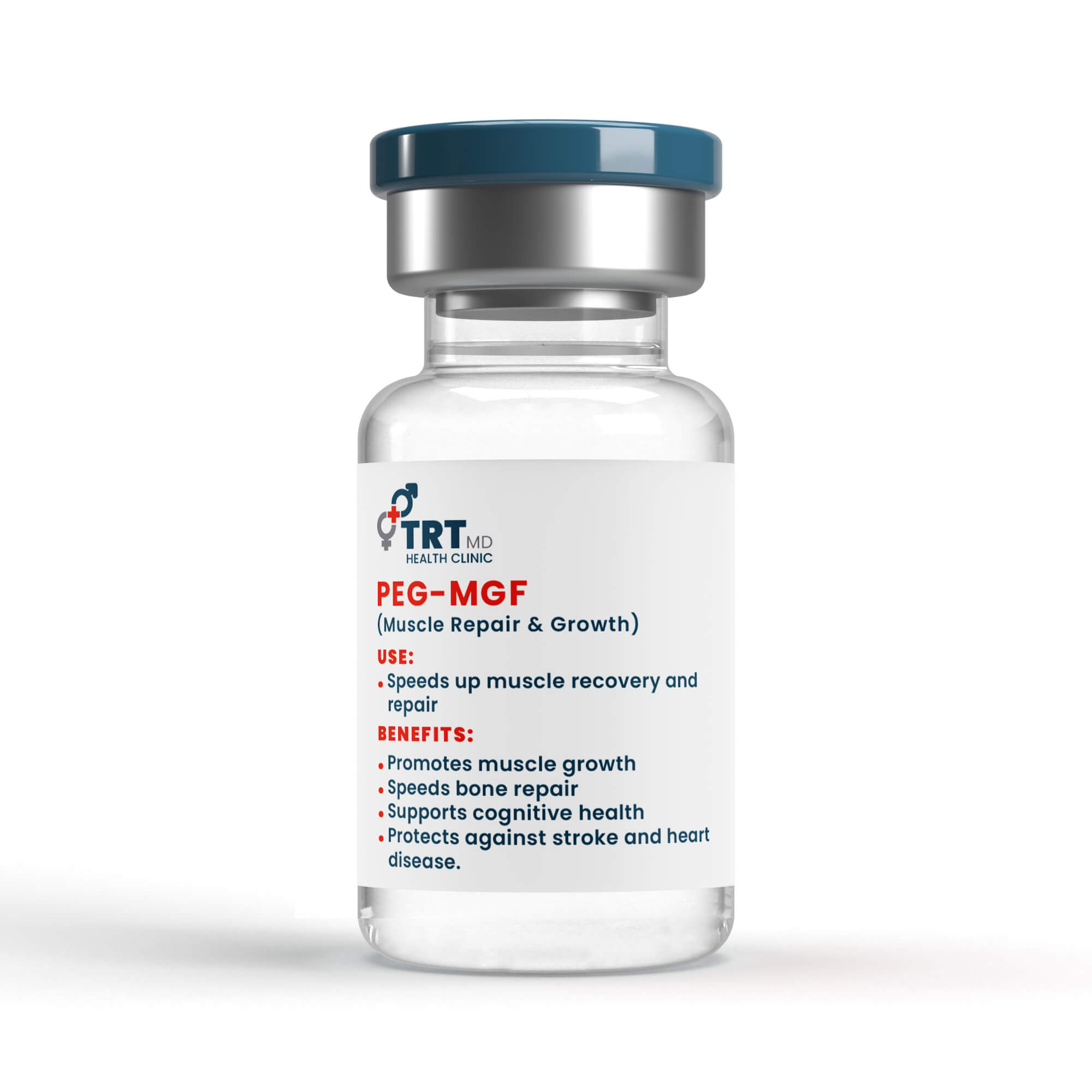
PEG-MGF (Muscle Repair & Growth): What the Science Actually Shows
PEG-MGF is a modified form of a natural muscle-repair signal your body makes when you train or get injured. The biology behind this peptide is real and documented in laboratory and animal research.
As a variant of IGF-1, it supports rapid muscle cell activation and regeneration, leading to stronger muscles, better performance, and quicker healing. PEG-MGF also boosts bone repair and reduces inflammation to improve recovery from fractures or intense physical activity.
Beyond muscle benefits, research shows positive effects on cognitive performance and cardiovascular protection, helping defend against aging-related decline. Here’s what’s genuinely known, what isn’t, and how to think about it.
What is PEG-MGF?
IGF-1 (insulin-like growth factor 1) is the main hormone growth hormone uses to build tissue. But the IGF-1 gene doesn’t make just one product, through alternative splicing (the cell reading one gene in different ways to make different proteins), it produces several variants. One of them, IGF-1Ec in humans, is the Mechano Growth Factor (MGF).
What makes MGF distinct is when and where it appears:
- It’s produced locally in muscle, at the site of stress or damage, not released from the liver like ordinary IGF-1
- It’s mechano-responsive, it switches on in response to mechanical loading like resistance training or injury. This was first characterized when Yang, Alnaqeeb, Simpson and Goldspink cloned an IGF-1 isoform expressed specifically in skeletal muscle subjected to stretch (J Muscle Res Cell Motil, 1996)
- It’s the first responder, it appears within hours of damage, before the slower systemic IGF-1 response
So MGF is essentially your muscle’s own locally-produced “start repair here” signal. It was discovered by Geoffrey Goldspink’s group at University College London, whose work established that the muscle’s post-exercise anabolic response involves a locally produced IGF-1 variant with distinct properties from systemic IGF-1, including earlier expression and preferential satellite cell activation.
Natural MGF lasts only minutes. PEGylation, attaching a polyethylene glycol molecule, extends its half-life to hours, which is what makes PEG-MGF a candidate for study as an injectable.
How PEG-MGF Works
Muscle repair depends on satellite cells, muscle stem cells that sit dormant against the fiber. Mature muscle fibers can’t divide to repair themselves; they rely on satellite cells to activate, multiply, and donate their nuclei to the damaged fiber. MGF’s proposed role is to activate those satellite cells, wake them and push them into the repair cycle.
The two-signal model came out of the Goldspink group’s work. Yang and Goldspink, in a 2002 FEBS Letters paper, characterized how the MGF E-peptide drives myoblast (muscle progenitor) proliferation, acting upstream and separately from the mature IGF-1 portion, which signals through the IGF-1 receptor to drive differentiation (FEBS Letters, 2002).
The following year, Hill and Goldspink reported that IGF-1 splicing in rodent muscle was associated with satellite cell activation following local tissue damage (J Physiol, 2003).
What this means is; MGF appears to handle the initiation of repair (waking the stem cells) through an IGF-1-receptor-independent mechanism, while ordinary IGF-1 handles construction. PEG-MGF’s logic is to extend that initiation signal beyond the body’s own short-lived pulse.
Note: all of the above is established in animal models and cell culture, not humans, and even there, it has not replicated cleanly.
In a notable 2013 study, two pharmaceutical companies attempted to reproduce the claimed effect of MGF peptides on human and mouse myoblasts and found that concentrations up to 500 ng/ml failed to increase proliferation, while mature IGF-1 did produce a proliferative response (Am J Physiol Endocrinol Metab, 2013). So the foundational mechanism is genuinely contested, not settled.
What PEG-MGF is being studied for
This is the upside, and it’s real research interest, not hype. Here’s where the research points:
- Muscle repair and recovery: The premise is that extending the MGF signal could support faster, more complete recovery from training or muscle damage, by keeping satellite cells mobilized longer.
- Muscle growth and adaptation: Because MGF acts upstream of the muscle-building process, researchers have studied whether prolonging it amplifies the adaptation that follows hard training.
- Age-related muscle loss (sarcopenia): One of the most promising directions. The satellite-cell activation that drives repair declines with age, and animal research suggests MGF may help restore some of that lost capacity, which is why it’s of interest for maintaining muscle and function later in life.
- Localized tissue repair. Because MGF acts locally rather than system-wide, there’s interest in its potential for targeted recovery at specific sites of injury.
These are the reasons PEG-MGF keeps the attention of researchers and the performance community. The mechanism gives each of them a sound biological rationale, which is what separates PEG-MGF from peptides with no coherent theory behind them.
Common uses and who’s interested in PEG-MGF
PEG-MGF tends to draw interest from a few specific groups, usually with recovery or performance as the underlying goal:
- Athletes and serious lifters focused on recovery between hard training sessions
- Active people dealing with a stubborn muscle injury who want to support localized repair
- Older adults concerned with preserving muscle mass and strength as the natural repair response slows
- People already exploring peptide therapy for recovery and performance who want to understand where MGF fits
What unites them is a goal; better recovery, preserved muscle, faster repair, rather than the specific molecule.
What research shows, and what it doesn’t
Supported (preclinical):
- MGF is a real, mechano-responsive IGF-1 splice variant with a documented role in muscle-repair signaling
- In animal and cell studies, the E-peptide has been linked to satellite-cell activation and muscle regeneration
- Human muscle does upregulate MGF after resistance exercise, and Hameed and colleagues found differences in IGF-1 splice variant expression between young and old human muscle after high-resistance exercise (J Physiol, 2003), the observation that motivates interest in MGF for age-related muscle loss
Not established:
- Every claim about what injected PEG-MGF does in people, builds muscle, speeds recovery, protects the heart or brain, is an extrapolation from animal and cell-culture data, not a demonstrated human effect.
- The cardio- and neuro-protective findings some pages cite (for example, a strong neuroprotective effect of the MGF C-terminal peptide in brain ischemia, FASEB J, 2005) are preliminary animal observations.
Current regulatory status for PEG-MGF
- Not currently eligible for legal compounding. When the FDA moved a group of peptides toward compounding access in 2026, PEG-MGF was specifically held back for separate review rather than cleared with the others (Frier Levitt regulatory analysis), with advisory-committee consultation anticipated before February 2027.
- On the WADA Prohibited List, banned for any tested athlete.
- Most PEG-MGF sold is unregulated “research use only” product, where independent testing has repeatedly found problems with purity, dosing, and even product identity.
Note: FDA approval is a process, not a verdict on whether something works, and an expensive one, built around patentable drugs with a commercial sponsor to fund the trials. For some treatments, particularly those using a patient’s own un-patentable biology, “unapproved” genuinely means “unfunded, not unproven.”
Safety considerations
- IGF-1 pathway and cancer risk, PEG-MGF acts on a growth-factor pathway, a real theoretical concern for anyone with active cancer, a cancer history, or elevated risk (especially IGF-1-linked cancers like breast, prostate, colorectal).
- Immunogenicity, injected peptides can trigger immune responses; no human data exists for PEG-MGF.
- Gray-market sourcing, unregulated vials carry direct contamination and infection risk, and may not contain what the label claims. Often the most immediate practical hazard.
Frequently asked questions
What’s PEG-MGF used for?
It’s studied primarily for muscle repair, recovery, muscle growth, and age-related muscle loss. These are research directions with strong biological rationale; human efficacy hasn’t been formally established yet.
How is it different from regular IGF-1?
Regular IGF-1 is the body-wide, liver-produced version that drives broad tissue growth. MGF is a local variant that appears at the site of muscle damage and specializes in the early step of waking up the muscle’s repair cells.
Is PEG-MGF banned in sports?
Yes, it’s on the WADA Prohibited List, so any athlete subject to testing should not use it.
If I’m interested in recovery, what should I actually do?
Start with a physician who can look at your goal and walk you through the recovery and performance options that are available and well-supported today, and keep PEG-MGF on your radar as its research matures.
Next Step
PEG-MGF is a genuinely promising piece of muscle science, an attempt to bottle the body’s own repair signal, with sound biology and encouraging early research behind it.
But the goal underneath the interest, better recovery, preserved muscle, faster healing, sustained performance as you age, is very much something you can act on today. There are recovery and performance therapies with solid evidence and clear regulatory standing, and the right one depends on your training, your goals, and your physiology.
That’s exactly the conversation TRTMD is built for. Rather than pointing you toward a research-only peptide, a physician-led consultation looks at what you’re actually trying to achieve and matches it to the options that are proven, available, and safe for you now, while keeping an eye on emerging compounds like PEG-MGF as the science earns its place. If recovery and performance are what brought you here, that’s the place to start.